Frequently asked questions
Everything you need to know about our lithium-ion fire equipment, from certification and warranty to storage, maintenance and shipping. Can't find your answer? Just get in touch.
General questions
Are the products certified and tested?+
There is currently no Australian Standard for lithium-ion battery fires, so no product sold in Australia carries an Australian lithium-ion rating. Instead, our equipment is tested and certified to European Standards, the highest benchmark available.
Our lithium-ion fire extinguishers comply with EN 3-7:2004+A1:2007, and our heavy-duty vehicle fire blanket is classified A2-s1, d0 to EN 13501-1:2018 (independently tested by SGS). Test reports and certifications are available on request.
Can I use the equipment for other types of fires?+
No. Our equipment is designed specifically for lithium-ion battery fires and isn't suitable for other fire types, which require different handling and extinguishing methods. Keep your standard fire safety equipment for those, and treat ours as a supplementary measure for lithium-ion risk.
Will a fire blanket put out a lithium-ion battery fire?+
Not completely. A fire blanket contains a lithium-ion fire and limits its spread, but it won't fully extinguish a battery that's already in thermal runaway, and nothing draped over a pack can. A cell in thermal runaway generates its own oxygen, so smothering alone does not stop the reaction. What a blanket does do is buy the critical minutes you need to get people clear and for fire services to arrive. For the best protection, pair a fire blanket with a lithium-ion fire extinguisher.
Is training required to use the products?+
No formal training is required to use our lithium-ion fire extinguishers and fire blankets. We do recommend reviewing the usage diagrams supplied with each product so you're familiar with them before an emergency.
What is the warranty on the products?+
All products come with a 12-month warranty.
Do you ship internationally?+
Yes, for containment bags. Our Premium Battery Bag and Laptop & Battery Bag ship worldwide at published per-item rates, shown at checkout: $50 to New Zealand, $80 to Asia Pacific, $90 to the USA and Canada, $95 to the UK and Europe, and $125 to the rest of the world. A discount applies to orders of two or more.
Extinguishers are pressurised and fire blankets are bulky, so freight on those varies widely by destination and we quote them individually. Email sales@evfiresolutions.com.au with the products, quantity and delivery address and we will come back with a freight cost for your country. Bulk and multi-site orders are welcome.
Any duties and taxes charged in the destination country are the responsibility of the customer. Full details are on our shipping policy page.
Do you offer bulk or trade pricing?+
Yes. We offer bulk discounts for commercial orders, plus volume and multi-site pricing for fleets, strata, facilities and resellers. See our Business & Bulk page, or contact our sales team to discuss a quote and custom solutions for your needs.
How long does shipping take?+
We hold Australian stock and dispatch orders within 48 hours of purchase. Once dispatched, allow 3 to 5 business days to metro areas, 3 to 7 business days to regional areas and 5 to 10 business days to remote locations.
International orders of containment bags usually take 6 to 27 business days, depending on your country's customs process.
How much does shipping cost?+
Shipping is charged per item, and a discount applies to orders of two or more. Rates run from $10 for our 2m x 2m blanket through to $80 for the heavy-duty 8m x 6m car blanket, with extinguishers from $20 to $40 and containment bags at $15. Kits are charged using the rates of the items inside them.
Every rate is listed on our shipping policy page, and the exact figure is shown at checkout before you pay.
Choosing the right product
Not sure what you need? Start here.
Do I need an extinguisher, a blanket, or both?+
They do different jobs. An extinguisher lets you tackle a fire early and cool the battery, interrupting thermal runaway. A blanket contains what you can't put out, limiting the spread while you wait for the brigade. For most situations we recommend both, which is why our kits and bundles pair them. If you can only start with one: an extinguisher is the more active first response for smaller batteries, and a blanket is the better single choice where containing a larger vehicle fire matters most.
Which size extinguisher do I need?+
It scales with the battery. The 1L suits e-bikes, e-scooters and small devices. The 4L suits mid-size cars, home garages and light-commercial use. The 9L is our largest, built for EV cars, home charging stations, warehouses, fleets and commercial sites. If you're between sizes or covering more than one risk, size up or ask us.
What size fire blanket covers my vehicle?+
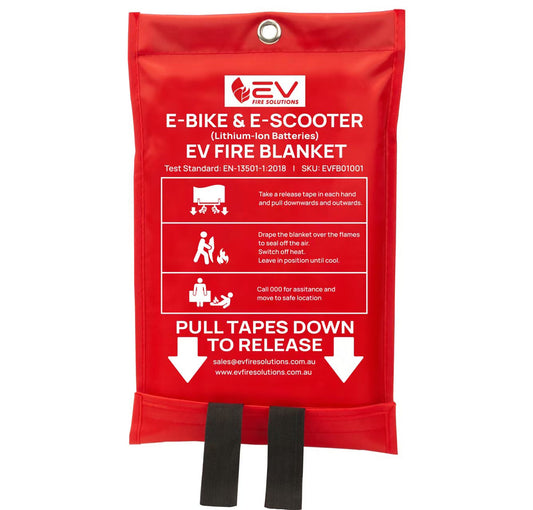
The 2m x 2m suits e-bikes, e-scooters and small equipment. The 5m x 5m suits smaller vehicles, mobility scooters and forklifts. The 8m x 6m is sized to fully cover a passenger EV or hybrid. Standard blankets are rated to a 1100 degrees C working temperature; heavy-duty versions are rated to 1600 degrees C for higher-risk settings.
What's the difference between standard and heavy-duty?+
The heat rating. Standard fibreglass blankets are rated to 1100 degrees C; heavy-duty high-silica blankets are rated to 1600 degrees C, our highest. Choose heavy-duty where maximum heat resistance is the priority, such as commercial, fleet and dealership use. Standard is a lower-cost choice for home and lighter use.
I have an e-bike or e-scooter. What's the minimum I should have?+
At a minimum, a way to respond to and contain a charging fire where you keep the bike. A 1L extinguisher plus a 2m x 2m blanket, available together as a kit, covers early response and containment. A containment bag adds a safer place to charge or store the battery, and is well worth it if you charge indoors or overnight.
What's the difference between a containment bag and a fire blanket?+
A blanket is draped over a fire to contain it once something has gone wrong. A containment bag is where you put the battery beforehand, to charge, store or transport it, so that if it fails the event is contained inside the bag. Many people use both: the bag for day-to-day risk, the blanket and extinguisher for active response. Note our bags are fire-resistant containment, not fireproof; they buy time and limit spread, they don't make a fire impossible.
Can you make a bag or blanket to my own dimensions?+
Yes. We manufacture containment bags, pouches, liners and blankets to specification, in standard silicone-coated fibreglass or heavy-duty high silica rated to 1600 degrees C, with your branding if you want it. There is no fixed minimum, single items can be made at a premium, and production runs six weeks from design approval.
See Custom Solutions for made-to-size items, or Packaging & Logistics if you need packaging for batteries in transit, storage or quarantine.
Lithium-ion battery safety
Useful whether or not you buy from us.
Why are lithium-ion battery fires different from normal fires?+
A failing lithium-ion cell enters thermal runaway: a self-sustaining reaction that generates its own heat and oxygen, produces toxic and flammable gases, and can reignite hours later. That's why ordinary approaches don't reliably work, and why cooling the battery and containing the fire matter more than smothering alone. In any fire, call 000.
What are the warning signs a battery is failing?+
Swelling or bulging, unusual heat, a hissing or popping sound, an odd chemical smell, smoke or vapour, discolouration, or leaking. If you notice any of these, stop using and charging the device, keep it away from anything combustible, and if it's safe, move it outside. If it's smoking or hot, treat it as an emergency and call 000.
What do I do if my battery is swelling or smoking?+
Don't use it or charge it, and don't puncture or crush it. If you can do so safely, move it away from people and anything that can burn, ideally outside onto a non-combustible surface or into a containment bag. If it's smoking, venting or hot, get clear and call 000. A swollen battery should be disposed of safely, not returned to use.
Can I pour water on a lithium-ion battery fire?+
Large volumes of water are what fire services use to cool an EV battery, but a household amount won't reliably stop thermal runaway and can create other hazards. For a small device fire, our lithium-ion extinguishers are designed to cool the battery and a blanket contains the spread. Whatever you have, if the fire is anything beyond a small early-stage one, evacuate and call 000.
How should I charge lithium-ion batteries safely?+
Charge on a hard, non-combustible surface, not on beds, sofas or carpet. Avoid charging unattended or overnight where you can't respond. Use the manufacturer's charger, don't cover the device while it charges, and stop using any battery that's damaged, swollen or behaving oddly. A containment bag adds a layer of protection if you have to charge indoors.
Where should I store spare or damaged batteries?+
Keep them cool, dry and away from combustible materials, and isolate anything damaged, swollen or recalled, ideally in a containment bag, while you arrange safe disposal. Don't store loose batteries where the terminals can short against metal objects such as keys or tools.
Commercial, strata & fleet
Do I need this for WHS or insurance compliance?+
There's no single Australian Standard for lithium-ion battery fires yet, but work health and safety duties and many insurers increasingly expect a documented risk control where these batteries are stored or charged. We can't give legal or insurance advice, but we can help you put a sensible layer in place. Check your specific obligations with your insurer and WHS adviser.
How many units do I need for a car park, warehouse or building?+
It depends on the size of the site, the number of charging or storage points, and how far someone would have to travel to reach the equipment. As a rule, position response gear within quick reach of each risk area rather than at one central point. Tell us your layout and we'll suggest a sensible spread.
Can you help with a bulk quote or multi-site rollout?+
Yes. For fleets, strata, facilities and resellers we offer volume and multi-site pricing and can help you specify the right mix. See our Business & Bulk page, or contact our sales team. We will tell you honestly what you do and do not need.
Do you offer training?+
Our equipment needs no formal training to use, and usage diagrams come with each product. We also offer awareness-level online courses on lithium-ion battery fire safety and safe EV charging, useful for giving staff a consistent, documented baseline. For hands-on firefighting training, contact your local fire brigade.
Storage & maintenance
Storing your lithium-ion fire extinguisher+
- Location: store it in a visible, easily accessible spot. Don't obstruct it with furniture or other items.
- Temperature: keep it in a temperature-controlled environment, ideally between 0°C and 49°C. Extreme heat or cold can affect the pressure gauge and performance.
- Mounting: mount it securely on the wall or in a designated bracket as per AS 2444, with the handle and nozzle pointing outward for easy access.
- Visibility: make sure it's clearly visible with appropriate location signage, as per AS 2444.
- Moisture: store it in a dry area to avoid corrosion, especially for metal-bodied extinguishers.
Maintaining your lithium-ion fire extinguisher+
- Regular inspections: check the pressure gauge is within the operational (green) range, and inspect for damage, rust or leaks.
- Seal and pin: ensure the safety pin is in place and the seal is intact. If the seal is broken, service or replace the extinguisher immediately.
- Condition: look for dents, rust or physical damage that may affect performance. Replace if damaged.
- Expiration: check the expiry date and replace when it expires, even if it hasn't been used.
- Professional servicing: have it professionally serviced and inspected at least once a year.
Storing your lithium-ion fire blanket+
- Location: keep it in an easily accessible spot near potential fire hazards, mounted somewhere visible and clear for quick access.
- Wall mounting: most blankets come with a mounting case or bracket. Install it securely so the blanket can be pulled free quickly when needed.
- Avoid obstruction: make sure it isn't covered by other items or stored where it could be damaged or blocked.
Maintaining your lithium-ion fire blanket+
- Regular inspections: check regularly for wear, tears or damage, and replace immediately if damaged.
- Cleanliness: keep it clean and free of dirt, debris and contaminants that could affect performance. Follow the manufacturer's cleaning instructions.
- Condition check: make sure it isn't folded incorrectly or stored in a way that could damage its fibres. It should always be ready to deploy immediately.
- After use: replace a blanket once it has been used, as they are designed for single use.
Still have a question?
We're happy to help you choose the right equipment, and we'll tell you honestly what you do and don't need.
SHOP BEST SELLERS
-
EV Fire Blankets for E-Bike and E-Scooter Lithium-ion Battery Fires: 10 Pack
Regular price $1,723.00 USDRegular price$2,368.00 USDSale price $1,723.00 USDSold out -
Fire-Resistant Laptop & Lithium-ion Battery Bag 40 × 28cm
Regular price $137.00 USDRegular price$137.00 USDSale price $137.00 USD -
 Sold out
8m x 6m EV Car Fire Blanket
Regular price $1,895.00 USDRegular price$0.00 USDSale price $1,895.00 USDSold out -
EV Fire Blankets suitable for E-Bike and E-Scooter Lithium-ion Battery Fires
Regular price $216.00 USDRegular price$237.00 USDSale price $216.00 USDSale